Free Ground Shipping on All Orders – 100% Satisfaction Guarantee

Sign in to like and rate
One knot is equal to 1.15 miles per hour or 1.85 kilometers per hour and one nautical mile is equal to 1.15 miles or 1.85 kilometers.
The term “knot,” in reference to measuring the speed of air and water currents as well as boats and aircrafts, is defined as one nautical mile per hour. A nautical mile is slightly more than a standard mile.
A chart can be found below to visually compare knots to miles per hour for better understanding.
Knots (KTS) | Miles Per Hour (MPH) |
1 knot | 1.15 mph |
5 knots | 5.75 mph |
10 knots | 11.5 mph |
25 knots | 28.8 mph |
50 knots | 57.5 mph |
100 knots | 115 mph |
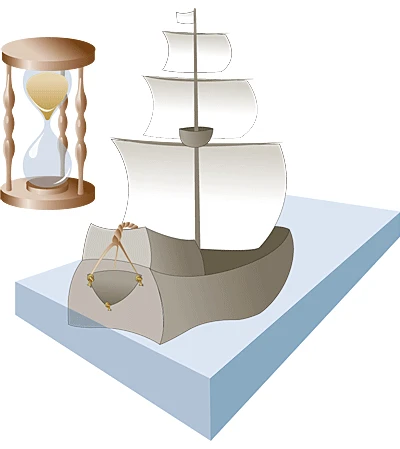
The term “knot” originated in the 17th century when sailors determined their speed through the water by using a device called a “chip log.” This device is a coil of rope with knots tied in it at specific increments, with a pie-shaped piece of wood attached to the end. To use it, the piece of wood was dropped off the stern of a ship and dragged behind the moving vessel. The rope was then spooled out freely as the piece of wood fell behind the ship for a specific amount of time. However many knots were dragged behind the boat by the piece of wood determined the speed of the ship, and the term “knot speed” was born.
Today, knots are still used in both maritime activities and aviation. While there have been different definitions of a nautical mile throughout history and in different regions, there is an international nautical mile that is used to measure knots today.

1 nautical mile equals 1.15 miles. The nautical mile is based upon the circumference of the Earth. If the equator was a circle, imagine it divided into 360 degrees like a compass. Now split each of those 360 degrees into 60 equal parts called “minutes.” The length of each “minute” along the circumference of the Earth is equal to approximately one nautical mile.
For example:
The length of a nautical mile is closely tied to the longitude and latitude of the Earth’s geographic coordinate system. Therefore, the knot and nautical mile are the units of choice in the marine and aviation industries.
Unit | Distance |
1 nautical mile (NM) | 1.15 miles |
1 nautical mile (NM) | 1.85 kilometers |
1 knot | 6,076 feet per hour |
Converting knots to miles per hour or kilometers per hour is straightforward once you know the conversion rates:
Here’s a simple chart to convert different speeds:
Knots (KTS) | Miles Per Hour (MPH) | Kilometers Per Hour (KPH) |
5 knots | 5.75 mph | 9.25 kph |
10 knots | 11.5 mph | 18.5 kph |
25 knots | 28.75 mph | 46.25 kph |
50 knots | 57.5 mph | 92.5 kph |
100 knots | 115 mph | 185 kph |
Knots are not just reserved for use on the water—they are also used in aviation to measure wind speed and aircraft velocity. Both industries rely on knots because their navigational charts are based on the Earth’s geographic coordinate system. Whether you’re at sea or in the air, knowing how to measure and understand knots can be crucial.
Knot speed is an integral part of weather forecasting, especially when dealing with marine conditions or aviation. Meteorologists often use knots to report wind speeds and ocean currents, helping sailors and pilots prepare for changing weather patterns.
Wind Speed | Knots (KTS) | Description |
Light breeze | 1–15 knots | Slight impact |
Moderate wind | 16–25 knots | Noticeable and may affect navigation |
Strong wind | 26–40 knots | Significant and potentially dangerous |
Gale-force winds | 41–55 knots | Severe conditions |
Knots are often used in place of miles per hour (MPH) for windspeed as the measurement of wind intensity originated in a nautical context. Sailors have not always had GPS navigation. The nautical mile was introduced in the 15th century, equal to 1.852 kilometers or 6,076 feet, as a standard against which to measure distance. The development of the nautical mile also led to the world’s first speedometer, the chip log. Over time, the chip log was standardized such that the chip was a quarter circle with either a five- or six-inch radius, and lead was added to the bottom of the chip to ensure that it submerged and oriented correctly to provide a more accurate and repeatable reading.
Understanding knot speed and its relationship to nautical miles and MPH is essential for anyone navigating the open ocean or the skies. Whether you’re a sailor, pilot, or weather enthusiast, learning about knots gives you the advantage of accurate navigation and forecasting. Maximum Weather Instruments — part of the IMTRA family of companies — offers a range of precision wind speed instruments like the Merlin and Maestro to help you stay prepared.

Please sign in to post a comment.